Meta Expands Audience Targeting with Exclusion‑Only Custom Audiences
Understanding the New Feature
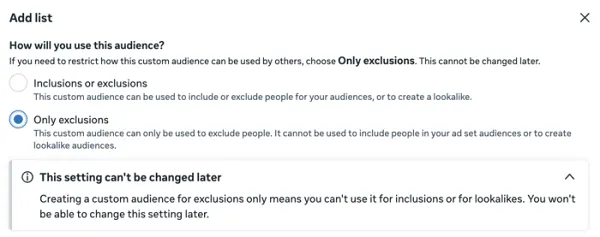
Meta has introduced a way for advertisers to build audiences that can only block people from seeing their ads. This “exclusion‑only” custom audience works like a regular custom list, but it’s limited to exclusion.
According to Meta’s own description, an exclusion‑only custom audience is a type of customer‑list audience that can be used solely to keep certain users out of a campaign. It cannot be used to add people to the audience, and once created it cannot be converted into a standard audience.
Why Marketers Might Want to Exclude Certain Users
There are several practical reasons to keep a group out of an ad set. First, it helps protect a brand from wasting money on users who have explicitly opted out of receiving promotions. By removing those individuals, advertisers reduce unnecessary impressions and spend.
Second, businesses that have legal or regulatory obligations—such as not targeting minors or specific demographic groups—can use the exclusion audience as a permanent safeguard. The feature acts as a guardrail that prevents accidental inclusion of prohibited users.
Third, the option can be handy for internal staff or employees. As Facebook ads expert Jon Loomer points out, excluding employees ensures that internal clicks don’t inflate metrics or drain budget on ads that have no real business value.
How the Feature Fits Into Existing Workflows
Advertisers already use custom audiences to combine inclusion and exclusion criteria. With the exclusion‑only audience, the workflow becomes more streamlined: you create a list, set it to “exclude only,” and apply it to any ad set without worrying that the list might also add people.
Because the audience cannot be changed into a regular audience after creation, it serves as a one‑way gate. This design reduces the risk of accidental inclusion when the same list is used elsewhere in the account.
Practical Examples
Imagine a retailer that runs a loyalty program. Users who have unsubscribed from email communications should never see promotional ads for those products. By building an exclusion‑only audience from the unsubscribe list, the retailer can keep its ad spend focused on engaged customers.
Another scenario involves compliance with data‑privacy regulations. If a company must not target residents of certain regions, it can upload a list of those residents and apply it as an exclusion‑only audience, ensuring that no ads are served to those users.
Expert Insight
Jon Loomer, a recognized Facebook ads strategist, suggests that exclusion‑only audiences are especially useful for eliminating “dead” spend. By removing employees, test users, or other non‑converting segments, advertisers can improve the efficiency of their campaigns.
He also notes that many use cases previously handled with standard custom audience exclusions can now be simplified with this dedicated exclusion‑only option, giving marketers more confidence in their targeting controls.
Overall, the feature adds a layer of safety and precision to Meta’s advertising platform, helping businesses protect their budgets, stay compliant, and avoid accidental exposure.