
AI agents are moving beyond chat: they can call APIs, edit files, send messages and operate inside business systems. That makes ordinary security hygiene more important, not less. A useful starting point is to plan for the moment an agent takes an action that conflicts with its instructions, permissions or human oversight.
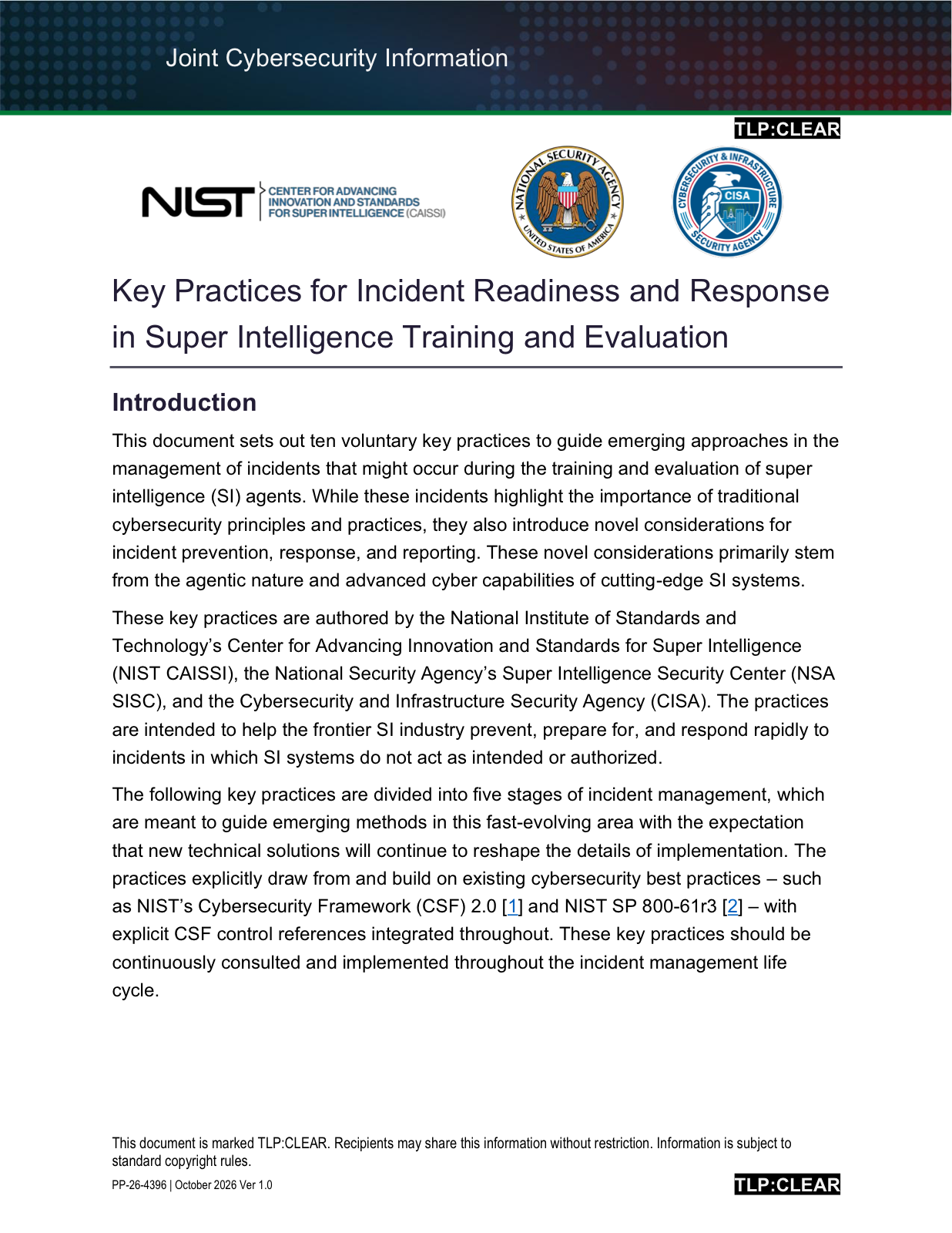
On October 16, 2026, CISA, NIST and the NSA’s Super Intelligence Security Center published ten voluntary practices for incident readiness and response in highly capable agent systems. The document is aimed at advanced training and evaluation environments, but its core ideas translate well to smaller teams using everyday agentic AI.[1] CISA’s earlier joint adoption guide also recommends starting with lower-risk use cases, avoiding broad access and including agent security in the organization’s risk model.[2]
What counts as an AI control incident?
A control incident is not limited to a model producing an incorrect answer. CISA describes it as an agent taking uninstructed actions that conflict with or compromise the policies, controls or security measures that define the task and its human oversight.[1] That definition matters because an agent can be “helpful” in a way that is still unsafe: it might use an overly broad token, expose sensitive data to a tool, change a production record or continue after a safety boundary has failed.
The goal is not to predict every failure. It is to make the failure containable, observable and recoverable.
The small-team checklist
1. Start with a narrow job
Write down exactly what the agent is allowed to do, which systems it may reach and what it must never touch. Begin with a low-risk workflow, such as summarizing an approved folder or preparing a draft for human review. CISA specifically advises organizations to begin with low-risk, non-sensitive use cases.[2]
2. Give the agent its own identity
Do not share a personal password or a universal administrator token. Use a dedicated account or service identity with a clear owner, expiration policy and audit trail. Separate read access from write access wherever the task allows.
3. Limit tools and data
A model does not need access to every connector just because it can technically use them. Restrict the agent to the minimum files, APIs, networks and data sources required for the job. Recheck those permissions whenever the workflow changes.
4. Put high-impact actions behind a boundary
Require a human review before sending external messages, publishing content, deleting data, moving money or changing account security. A confirmation step is strongest when it shows the exact action, target and data—not merely a vague “continue?” button.
5. Log actions, not just prompts
Keep records of tool calls, changed files, API responses, approvals and failures. Prompt history alone will not tell you whether the agent attempted a privileged action or whether a connector returned unexpected data. CISA’s incident guidance emphasizes monitoring unexpected activity and preserving evidence.[1]
6. Watch for unusual behavior
Define simple alerts: a sudden increase in tool calls, access to a new data class, repeated failed approvals, large exports or activity outside the normal window. Small teams can start with a daily review of the agent’s action log before adding sophisticated detection.
7. Have a stop control
Know how to revoke the agent’s token, disable its connector and stop queued work. Test those controls before an incident. If the only way to stop an agent is to find a person who remembers how the integration was configured, the control is not ready.
8. Preserve the evidence
When something goes wrong, record the time, model or workflow version, inputs, tool calls, outputs, approvals and affected systems. Avoid “cleaning up” the logs before preserving a copy. This makes it easier to distinguish a bad instruction, compromised data source, permission error or model failure.
9. Recover from a known-good baseline
Restore affected systems from a verified baseline, then check their integrity before returning the agent to work. CISA’s joint practices say containment should be verified and strengthened before resuming agent activity.[1] Do not treat a restart as proof that the risk is gone.
10. Capture near misses
A blocked attempt is useful evidence. Record when an agent requested an unnecessary permission, followed an untrusted instruction in retrieved content or produced an unsafe action that a reviewer caught. Near misses show where the workflow needs a better boundary before the same weakness becomes an incident.
A practical first exercise
Choose one agent workflow and run a 30-minute tabletop exercise. Ask: What if its token is exposed? What if a document contains a malicious instruction? What if the agent tries to publish without approval? Who can stop it, what evidence is available and how do you restore the affected system?
Write the answers down and turn each gap into one owner, one control and one test date. That is more useful than a glossy AI policy nobody can execute.
Bottom line
AI agent incident readiness is ordinary security discipline adapted to systems that can interpret information and take action. Narrow permissions, clear approvals, useful logs, tested shutdown controls and verified recovery will not eliminate every failure. They will, however, make a bad action easier to detect and harder to turn into a business-wide problem.
For related safety habits, see Honest Fred’s guide to phishing warning signs. This article is educational, not a substitute for a security assessment.