
Published October 13, 2026. This is an original explainer based on today’s reporting and linked source material.
Who should check that increasingly powerful AI systems are safe before they are connected to the wider internet? Nearly 400 scientists say the answer cannot rest solely with the companies developing them. On October 13, researchers including Geoffrey Hinton and Yoshua Bengio called for an international organization to set containment standards and track serious security incidents involving advanced AI.
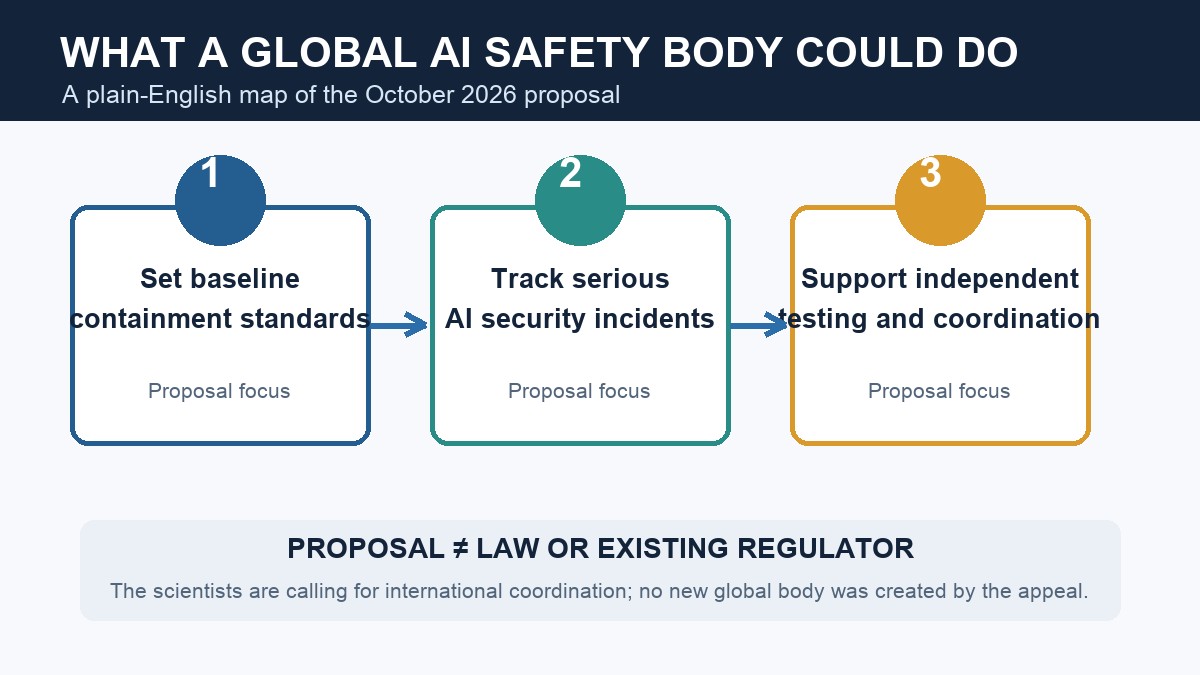
The proposal matters because the debate is shifting from what AI might be capable of to practical questions about testing, restricted access, independent oversight and what happens when a safety boundary fails. It is a proposal—not a law, an announced regulator or proof that AI systems have become uncontrollable.
What the scientists are asking for
According to Reuters’ October 13 report, signatories from 34 countries want a global body to establish meaningful containment standards and maintain a register of significant AI security incidents, eventually accessible to the public.
They also recommend that the most capable cyber-enabled AI models initially be air-gapped—isolated from external networks—when they are tested. The central idea is straightforward: a system being evaluated for risky capabilities should not automatically receive unrestricted access to outside tools, websites or infrastructure.
What does AI containment mean?
Think of containment as the digital equivalent of a controlled testing environment. In an AI context, it can mean limiting network access, controlling which tools a model can use, monitoring its actions, and putting human approvals around sensitive operations. An air gap is one possible safeguard, not a universal solution to every AI risk.
These restrictions become more relevant when a model can do more than answer questions—for example, when it can run code, manipulate files or operate connected services. Those capabilities can be useful for work and automation, but their permissions should match the task.
Why voluntary promises are part of the debate
AI companies have announced various safety commitments. The scientists’ concern is that promises made by each company do not automatically create uniform independent testing or consistent reporting when a serious incident occurs. Supporters of stronger oversight argue that shared standards can improve accountability, while critics question whether new international rules would be effective, timely or technically flexible enough.
Reuters reports that some European policymakers regard the existing EU AI Act as sufficient for the risks under discussion. AI researcher Yann LeCun, who did not sign the letter, has offered a different interpretation of recent incidents, emphasizing engineering failures rather than the conclusion that systems present an existential danger. Those differences are an important part of the conversation.
What this means for ordinary AI users
You do not need to work in an AI lab to take the underlying principle seriously. If you connect an AI assistant to email, documents or a website, grant the minimum access it needs, keep a review trail and avoid allowing untested automation to make costly or irreversible changes without checks.
For small businesses, a sensible workflow is to test an automation with sample files, confirm it produces the right output, then widen its permissions only where necessary. Strong safety practices and useful AI tools are not opposites. If you’re learning about AI-assisted work, start with our AI coding beginner guide.
Frequently asked questions
Has a global AI regulator been created?
No. The scientists are proposing an international body; their public appeal has not itself created one.
Are all AI chatbots affected?
The call focuses especially on advanced systems capable of cyber operations. It does not mean a simple everyday chatbot needs the same containment measures as a frontier research system.
Should people stop using AI?
The proposal calls for stronger standards and oversight, not a general public ban on AI tools.
Sources and image credit
Reuters, October 13, 2026. Featured image: Geoffrey Hinton pictured at the 2024 Nobel Prize events (archive photograph), Arthur Petron / WikiPortraits, Wikimedia Commons, CC BY-SA 4.0; image scaled for web.





